Counterfeit currency continued to impact businesses across the country throughout October, with cases involving fake $100 bills, altered genuine currency, repeat retail fraud and counterfeit cash passed at small local businesses.
This month’s stories show why businesses of all sizes need a consistent process for checking cash before a transaction is completed.
Here are four notable counterfeit cash stories from October and what businesses can learn from them.
1. Counterfeit $100 Bills Reported at New York Orchard
Weed Orchards in Marlboro, New York, reported that at least three suspected counterfeit $100 bills were allegedly passed at its bakery, bar and café during a busy fall weekend.
The business later turned to social media for help identifying the individual believed to have used the bills and began reviewing additional surveillance footage and weekend receipts to determine whether more counterfeit money had been accepted.
Business Takeaway: Busy seasonal businesses can be especially vulnerable when employees are handling large volumes of transactions. Higher-denomination bills should be checked before change or merchandise is handed over.
2. Man Accused of Passing Counterfeit Cash at Target More Than 100 Times
A Milwaukee man is accused of using counterfeit $100 bills at Target stores at least 114 times over several years.
According to court records cited by WISN, Target had maintained a theft file related to the suspect since 2021, with losses totaling nearly $25,000. He also faces forgery charges in Iowa stemming from alleged counterfeit transactions at Target locations there.
Business Takeaway: Counterfeit fraud is not always a one-time event. Repeat offenders may target the same retailer or chain multiple times, making consistent detection procedures and employee training especially important.
3. Altered $10 Bill Passed as a $50 in Indiana
Businesses in St. Joseph County, Indiana, warned others after counterfeit $50 bills began appearing in the area.
One local ice cream shop accepted what appeared to be a $50 bill. The bill passed a counterfeit detector pen test, but a bank later determined that it was actually a genuine $10 bill that had been altered to appear to be worth $50.
Because the original paper was genuine U.S. currency, the bill was able to pass a paper-based counterfeit detector pen test.
Business Takeaway: A counterfeit detector pen is an important first line of defense, but altered or “bleached” bills demonstrate why businesses should also verify denomination-specific security features such as the security thread, watermark and UV features.
4. Counterfeit $100 Bills Used at Multiple Georgia Businesses
The Dalton Police Department is investigating a series of incidents involving counterfeit $100 bills used at several local businesses.
Police said one suspect allegedly used multiple $100 bills to load money onto a Cash App card at a Walgreens. Other businesses reportedly accepted counterfeit $100 bills for low-cost purchases, allowing the suspects to receive large amounts of genuine cash as change.
According to police, the counterfeit bills were slightly thicker and stickier than genuine currency and were detected when tested with a counterfeit detector pen.
Business Takeaway: Small purchases made with large-denomination bills can be a warning sign. Employees should verify $50 and $100 bills before completing the transaction, particularly when a customer is purchasing a low-cost item and expecting significant change.
What October’s Counterfeit Cases Tell Businesses
This month’s cases highlight several recurring counterfeit-cash risks:
- Counterfeiters continue to target both national retailers and small businesses.
- $50 and $100 bills can create significant losses when accepted without proper verification.
- Altered genuine currency may pass a traditional counterfeit detector pen test.
- Criminals may use counterfeit cash to obtain genuine change, gift cards or stored-value funds.
- Repeat offenders can cause substantial losses over time.
The biggest lesson is that no single detection method catches every type of counterfeit bill.
Tip of the Month: Check More Than the Paper
Traditional counterfeit detector pens test the paper used to produce U.S. currency, making them a fast and convenient first test.
However, altered genuine bills demonstrate why businesses should also verify additional security features.
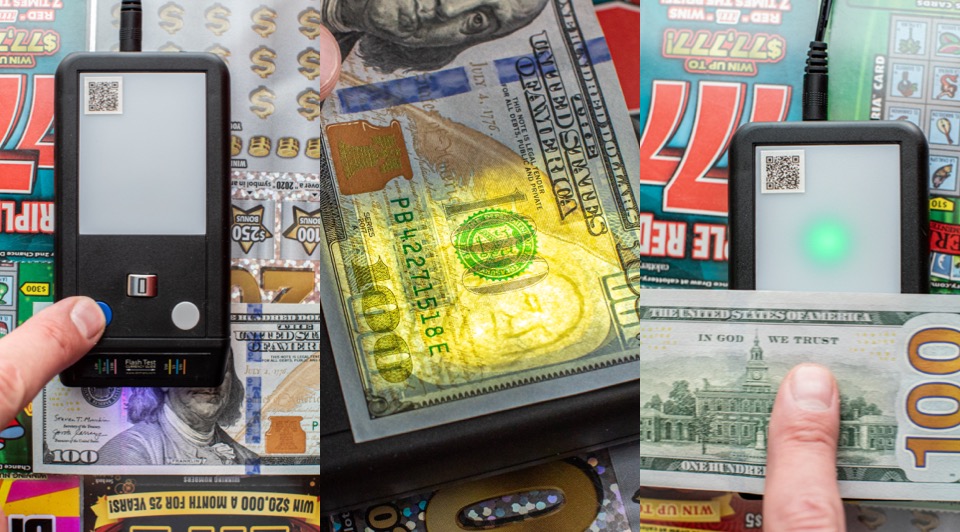
Dri Mark offers detection solutions that combine multiple tests, including counterfeit detector pens, UV security-feature verification, watermark inspection and magnetic ink detection, helping businesses add another level of protection at the point of sale.
Taking a few extra seconds to verify a bill can help prevent a much larger loss.