Counterfeit currency continued to make headlines across the United States throughout September, affecting casinos, retailers and local communities.
This month’s cases show just how varied counterfeit activity can be from fake bills used at a blackjack table to altered genuine currency and counterfeit $100 bills found during an arrest.
Here are five notable counterfeit cash stories from September and what businesses can learn from them.
1. $460 in Counterfeit Cash Used at Mount Airy Casino Blackjack Table
Pennsylvania State Police are investigating after counterfeit cash was allegedly used during a blackjack game at Mount Airy Casino Resort in Paradise Township, Pennsylvania.
According to police, a person bought into a blackjack game using $460 in counterfeit bills. Casino personnel discovered the bills were counterfeit after the individual had already left the property.
At the time of the report, police had not released suspect information or announced any arrests.
Business Takeaway: Casinos handle high volumes of cash, often in fast-paced environments. This case is a reminder that counterfeit bills can surface anywhere cash changes hands. Verifying bills before completing a transaction can help prevent losses that may be difficult to recover afterward.
2. Four South Carolinians Indicted in Counterfeit Currency and Wire Fraud Case
Four South Carolina residents were indicted by a federal grand jury in September in connection with an alleged counterfeit currency and wire fraud conspiracy.
Federal prosecutors allege that the scheme involved bleaching genuine $10 bills and printing images of $50 bills onto them. The altered bills were then allegedly loaded onto Cash App accounts at Dollar General stores throughout South Carolina before the funds were transferred among the defendants.
The case was investigated by the U.S. Secret Service and local law enforcement agencies. The charges are allegations, and the defendants are presumed innocent unless proven guilty.
Business Takeaway: Counterfeit currency is not always created from ordinary printer paper. Altering genuine currency can make detection more challenging because the paper itself may be authentic. Businesses should train employees to check multiple security features rather than relying on appearance alone.
3. Georgia Forgery Suspect Allegedly Found With Eight Counterfeit $100 Bills
Authorities in Stephens County, Georgia, reported finding eight suspected counterfeit $100 bills while arresting a man already wanted on forgery and theft warrants.
According to the Stephens County Sheriff’s Office, deputies arrested the 25-year-old suspect at a convenience store in Toccoa on September 21. During a search following the arrest, authorities reported finding the suspected counterfeit currency along with suspected methamphetamine, pills and other items.
The suspect subsequently faced additional charges, including first-degree forgery.
Business Takeaway: Higher-denomination counterfeit bills can represent a substantial loss for any retailer. A handful of fake $100 bills can quickly add up, especially if they are successfully passed at multiple businesses before being detected.
4. Counterfeit Currency Reported in Milbank, South Dakota
A September report from KXLG Radio warned of counterfeit currency being reported in Milbank, South Dakota.
Reports like this are particularly important for local retailers, restaurants and other small businesses because counterfeit bills can quickly circulate throughout a relatively small community.
When local authorities or news outlets report counterfeit money in the area, businesses should alert employees and reinforce their cash-verification procedures.
Business Takeaway: Counterfeit cash is not limited to major cities or large retail centers. Small communities can also experience counterfeit activity, making employee awareness and consistent bill checking important regardless of a business’s location.
5. Counterfeit $100 Bills Allegedly Used to Purchase Gift Cards at Oregon Safeway Stores
An investigation involving the Oregon Department of Justice and Safeway’s Organized Retail Crime team led to indictments against two people accused of manufacturing and using counterfeit $100 bills.
Authorities allege the counterfeit bills were used to purchase gift cards at Safeway stores across Oregon.
Investigators later executed search warrants at two residences and reported seizing chemicals, printers and digital devices believed to have been used in the production of counterfeit U.S. currency. The charges are allegations, and the defendants are presumed innocent unless proven guilty.
Business Takeaway: Gift cards can be especially attractive in fraud schemes because they allow someone to convert fraudulent currency into another form of value. Cashiers should use extra caution when customers make large gift-card purchases using $50 or $100 bills.
What September’s Counterfeit Cases Tell Businesses
September’s cases demonstrate how counterfeit cash can appear in very different types of transactions from casino gaming and convenience-store encounters to gift-card purchases and everyday retail transactions.
Several important themes stand out:
- High-denomination bills remain an important area of concern.
- Counterfeiters may alter genuine currency to make fake bills more convincing.
- Gift cards can be used to turn counterfeit cash into easily transferable value.
- Counterfeit currency can surface in both large metropolitan areas and small communities.
- Fast-paced transactions can make it easier for suspicious bills to go unnoticed.
- Businesses benefit from using more than one method of counterfeit detection.
The best defense is preparation. Employees who regularly accept cash should know what security features to look for and have a clear process for handling bills that appear suspicious.
Tip of the Month: Use More Than One Test
The South Carolina case involving altered $10 bills is a good reminder that counterfeit currency is becoming increasingly sophisticated.
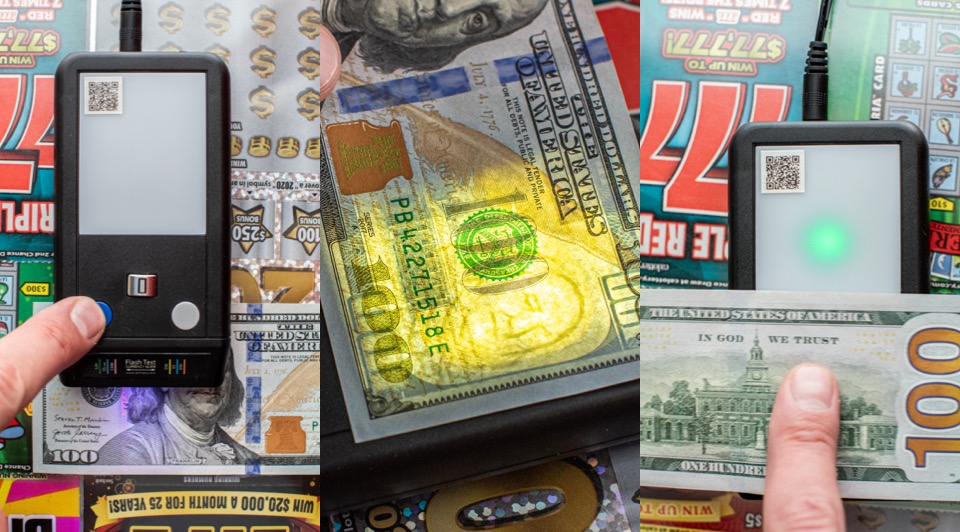
Instead of relying on a quick visual inspection alone, businesses should consider checking multiple security features, particularly on $50 and $100 bills.
Dri Mark offers several levels of counterfeit detection from the Original Counterfeit Detector Pen for fast point-of-sale testing to detection solutions that incorporate additional tests such as UV security-feature verification and magnetic ink detection.
Taking a few extra seconds to verify a bill can help prevent a much larger loss.
Shop Dri Mark Counterfeit Detection Solutions HERE